
How Activated Carbon Removes BOD and TSS
Activated carbon reduces BOD and TSS through two distinct but complementary mechanisms that operate simultaneously within a packed carbon bed:
- BOD removal — adsorption. The dissolved organic compounds that contribute to BOD—humic acids, proteins, carbohydrates, fatty acids, and residual organic chemicals—are captured within the carbon’s pore structure through physical adsorption. These molecules diffuse into the micropore and mesopore network and are held there by van der Waals forces. The driving force for adsorption is the concentration gradient between the bulk liquid and the carbon surface; as the organic molecules bind to active sites on the carbon, more diffuse in from the liquid phase. BOD reduction of 60–90% across a GAC bed is typical for secondary effluent, depending on the organic composition and the carbon dose or empty bed contact time (EBCT).
- TSS removal — physical filtration. Suspended solids in wastewater effluent range from 1–100 μm in size. As the water passes through the granular carbon bed, these particles are trapped in the interstitial spaces between carbon granules through mechanical straining (for larger particles >20 μm) and surface-contact capture (for smaller particles that follow flow streamlines close to the granule surface). TSS removal of 70–95% is readily achievable in a well-designed GAC filter, with the upper end of the range depending on the depth of the bed and the filtration velocity.
An important operational consideration is that over time, captured TSS accumulates within the bed, increasing head loss and eventually requiring backwashing to flush the accumulated solids out of the carbon layer. A well-designed GAC system for tertiary treatment will incorporate regular backwash cycles (typically every 24–72 hours, depending on solids loading) to maintain hydraulic capacity while preserving the carbon’s adsorptive function for BOD removal.
Recommended Activated Carbon Types for BOD/TSS Removal
For municipal and industrial wastewater tertiary treatment, the choice of activated carbon depends on the configuration of the polishing system and the target effluent quality:
Granular Activated Carbon (GAC) — Recommended for continuous systems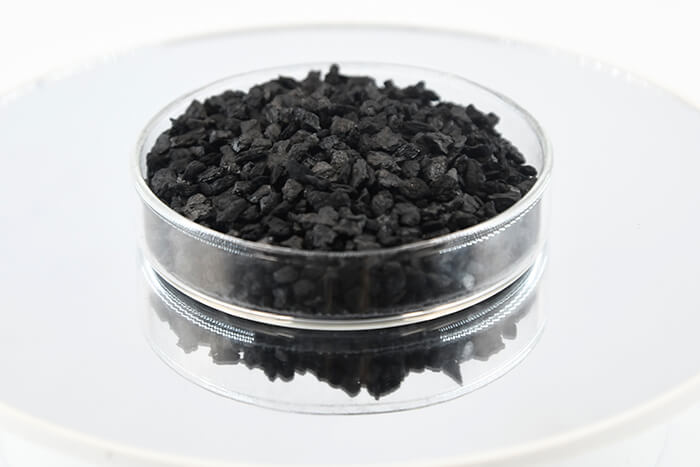
GAC in fixed-bed downflow or upflow columns is the standard configuration for tertiary BOD/TSS polishing. The carbon provides both adsorption of dissolved organics and depth filtration of suspended solids in a single unit operation. Coconut-shell-based GAC is preferred for its high hardness (≥ 97%), which resists attrition during backwash cycles, and its natural low ash content (≤ 5%), which minimizes leaching of metal ions into the treated effluent. Typical mesh sizes are 8×30 or 12×40, balancing filtration efficiency with hydraulic capacity. Coal-based GAC is a more economical alternative for larger plants where TSS loading is moderate and backwash frequency is manageable.
Powdered Activated Carbon (PAC) — For batch or seasonal polishing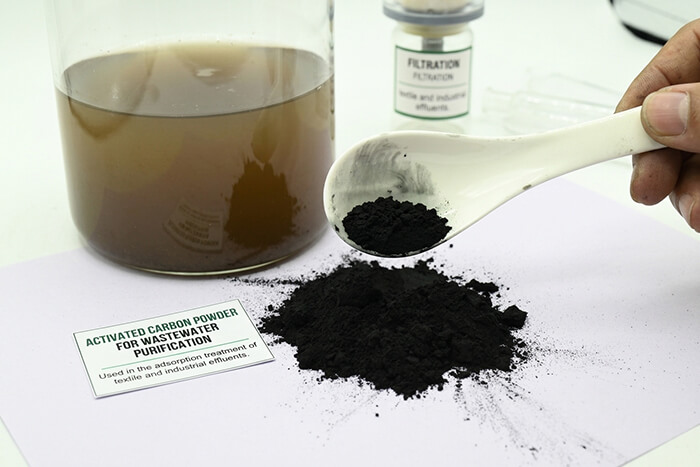
PAC can be dosed directly into the final clarifier or a contact tank when BOD polishing is needed only periodically (e.g., seasonal load variations) or when existing infrastructure cannot accommodate GAC columns. PAC dosage of 10–100 mg/L is typical, with higher doses required for wastewater with high soluble BOD fractions. However, PAC does not provide TSS removal on its own and must be paired with a downstream clarification or filtration step.
Typical Specifications for Wastewater Polishing GAC
The table below summarizes the recommended specifications for granular activated carbon used in BOD and TSS removal service:
| Parameter | Coconut-Shell GAC | Coal-Based GAC |
|---|---|---|
| Iodine Number (mg/g) | ≥ 1,000 | ≥ 900 |
| Mesh Size | 8×30 or 12×40 | 8×30 or 8×40 |
| Effective Size (mm) | 0.55–0.80 | 0.55–0.95 |
| Uniformity Coefficient | ≤ 1.9 | ≤ 2.1 |
| Hardness (%) | ≥ 97 | ≥ 93 |
| Ash Content (%) | ≤ 5 | ≤ 12 |
| Bulk Density (kg/m3) | 450–530 | 520–620 |
Key Design and Operating Parameters
The performance of a GAC system for BOD and TSS removal depends on several design and operating variables that must be matched to the specific wastewater characteristics and treatment targets:
- Empty Bed Contact Time (EBCT). The most critical design parameter. For BOD removal, an EBCT of 15–40 minutes is typical for secondary effluent polishing. Longer EBCTs provide more complete adsorption of slowly diffusing organic molecules but require larger vessels. TSS removal is less sensitive to EBCT and more dependent on bed depth and filtration velocity.
- Filtration velocity (linear loading rate). Typically 5–15 m/h (2–6 gpm/ft2) for gravity-flow or pressurized GAC filters. Higher velocities increase throughput but reduce TSS capture efficiency and accelerate head-loss development. For TSS-dominant applications, lower velocities (5–8 m/h) are recommended.
- Bed depth. Minimum 1.5–2 meters for combined BOD/TSS removal. Deeper beds provide greater contact time for adsorption and longer solids-retention capacity before backwashing is required. Maximum practical depth is 3–4 meters in single-stage downflow columns.
- Backwash frequency and intensity. For TSS-laden GAC beds, backwashing every 24–72 hours is typical. Backwash at 30–50% bed expansion (8–15 m/h water rise rate) for 10–15 minutes, followed by a brief rinse at operating flow. Backwash water should be treated wastewater or clean water to avoid recontaminating the bed.
- Carbon service life. In tertiary BOD/TSS service, GAC typically lasts 12–24 months before the adsorption capacity for soluble BOD is exhausted and the carbon must be replaced or reactivated. TSS removal continues even after the adsorptive capacity is depleted, as the granular carbon continues to function as a depth filter medium.
BOD/TSS Removal in Integrated Treatment Schemes
The most common configuration for activated carbon in BOD/TSS removal is as a tertiary polishing step after secondary biological treatment. In this role, the carbon bed handles inlet BOD of 10–40 mg/L and TSS of 10–60 mg/L, producing effluent with BOD and TSS consistently below 10 mg/L (often below 5 mg/L for well-designed systems). This quality is suitable for discharge to sensitive receiving waters, reuse in industrial cooling or process applications, or feed to reverse osmosis membranes for advanced water reclamation.
In some configurations, powdered activated carbon is added directly to the biological treatment step (the PACT process), where the carbon adsorbs inhibitory organic compounds and enhances biomass settling. This approach can improve BOD removal in the biological stage itself but does not replace the need for a final polishing step for TSS control.
Conclusion
Activated carbon is a proven and practical solution for reducing BOD and TSS in wastewater treatment, serving as a reliable tertiary polishing step that bridges the gap between biological treatment performance and regulatory discharge requirements. Granular activated carbon in fixed-bed columns combines adsorption of soluble organic compounds with depth filtration of suspended solids in a single unit operation, delivering effluent that consistently meets the tightest BOD and TSS discharge limits. Zhulin Carbon supplies coconut-shell-based and coal-based GAC grades specifically formulated for wastewater polishing applications, with high hardness for backwash durability, appropriate mesh sizes for hydraulic performance, and certified iodine and molasses numbers for predictable organic adsorption. Contact us through the inquiry form below for product data sheets, pricing, or to discuss the optimal carbon selection for your treatment plant’s specific effluent quality targets.