
Per- and polyfluoroalkyl substances (PFAS) — often called “forever chemicals” — have become one of the most pressing environmental challenges of our time. Among them, Perfluorooctanoic acid (PFOA) is particularly concerning due to its persistence, bioaccumulation, and links to adverse health effects. Found in industrial wastewater from electroplating, semiconductor manufacturing, textile waterproofing, firefighting foam runoff, and chemical production, PFOA resists conventional biological and chemical treatment methods.
At Zhulin Carbon, we have helped industrial facilities and environmental engineering firms achieve reliable PFOA removal using our coal-based extruded crushed granular activated carbon (GAC). In this guide, we explain why activated carbon is the most effective technology for PFOA removal, why extruded crushed carbon outperforms other carbon types, and what specifications matter most.
What Is PFOA and Why Is It So Difficult to Remove?
PFOA (Perfluorooctanoic acid, C₈HF₁₅O₂) is a synthetic perfluorinated carboxylic acid. Its molecular structure — a chain of eight carbon atoms fully saturated with fluorine atoms — gives it exceptional thermal and chemical stability. This is exactly why it was so useful in industry, but also why it is so difficult to degrade in the environment:
- the carbon-fluorine bond is one of the strongest in organic chemistry (~480 kJ/mol),
- PFOA is resistant to biodegradation, photolysis, and most advanced oxidation processes,
- it is highly water-soluble and mobile, spreading quickly through water systems,
- it bioaccumulates in humans and wildlife, with a half-life of several years.
Conventional wastewater treatment plants (WWTPs) are not designed to remove PFOA — studies show that most WWTPs pass PFOA through with little to no removal. Adsorption onto activated carbon has emerged as the most proven, cost-effective, and widely deployed technology for PFOA and PFAS removal.
How Activated Carbon Removes PFOA
Activated carbon removes PFOA through a combination of physical adsorption and electrostatic interactions. The mechanism works as follows:
- The fluorinated carbon chain of PFOA is both hydrophobic and lipophobic, making it naturally attracted to the non-polar surface of activated carbon.
- PFOA molecules (molecular length ~9.8 Å) are captured in the micropores (<20 Å) and mesopores of the carbon, where van der Waals forces hold them firmly.
- At typical wastewater pH, PFOA exists as an anion (PFOA⁻). The surface chemistry of activated carbon — particularly oxygen-containing functional groups — can provide adsorption sites for these anionic species.
- With a BET surface area of 900–1,100 m²/g, activated carbon provides an enormous contact area for PFOA molecules to adhere to.
Research and full-scale installations consistently show that granular activated carbon (GAC) can reduce PFOA concentrations from parts-per-billion (ppb) levels down to below detection limits (<10 ppt), meeting or exceeding current regulatory standards such as the U.S. EPA health advisory level of 0.004 ppt for PFOA.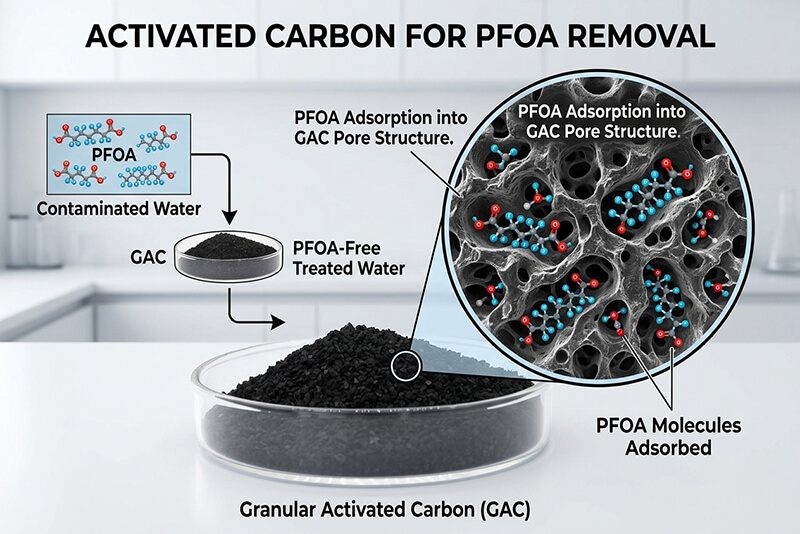
Why Extruded Crushed Carbon Is the Best Choice for PFOA Removal
Not all activated carbons perform equally for PFOA removal. Based on extensive field experience and comparative testing, we recommend coal-based extruded crushed carbon (also called briquetted broken carbon) for this application. Here is why:
- The extrusion and crushing process creates a balanced distribution of micropores and transport pores (mesopores/macropores), which is critical for adsorbing PFOA molecules while maintaining fast diffusion kinetics.
- With a hardness of ≥95%, extruded crushed carbon withstands the mechanical stress of backwashing, transport, and thermal regeneration without generating excessive fines — a major advantage over direct-activation carbon.
- A bulk density of 0.48–0.55 g/cm³ means more carbon mass per unit volume in your adsorber vessel, translating to greater total PFOA adsorption capacity and longer bed life.
- Spent extruded crushed carbon can be thermally regenerated multiple times with minimal capacity loss, significantly reducing lifecycle costs.
- The briquetting process produces a uniform raw material, resulting in batch-to-batch consistency in pore structure and adsorption performance.
- Coal-based extruded carbon offers the best price-to-performance ratio for large-scale PFOA remediation projects compared to coconut shell carbon or reactivated carbon.
Technical Parameters of Our Extruded Crushed Carbon for PFOA Removal
| Parameter | Unit | Specification | Why It Matters for PFOA Removal |
| Raw Material | — | Selected anthracite & bituminous coal | High carbon content, low impurity base |
| Manufacturing Process | — | Briquetting → Carbonization → Steam activation → Crushing → Screening | Engineered pore structure |
| Particle Size | mesh | 8×30 (0.60–2.36 mm) / 12×40 (0.42–1.70 mm) | Optimized for fixed-bed adsorbers |
| Effective Size (d₁₀) | mm | 0.55 – 0.80 | Balances flow rate and contact efficiency |
| Uniformity Coefficient | — | ≤ 1.9 | Minimizes channeling, ensures even flow distribution |
| Iodine Number | mg/g | ≥ 950 | Indicator of micropore development |
| Methylene Blue Adsorption | mg/g | ≥ 180 | Mesopore capacity for larger organics |
| Specific Surface Area (BET) | m²/g | ≥ 1,000 | Maximum adsorption sites for PFOA molecules |
| Total Pore Volume | cm³/g | ≥ 0.50 | Adequate space for molecular diffusion |
| Apparent / Bulk Density | g/cm³ | 0.48 – 0.55 | High mass per volume → longer bed life |
| Hardness / Abrasion Number | % | ≥ 95 | Resists fines generation during operation |
| Ash Content | % | ≤ 10 | Low inorganic impurities |
| Moisture (as packed) | % | ≤ 5 | Maximum active carbon content |
| pH | — | 6 – 9 | Compatible with most wastewater matrices |
| Water-Soluble Ash | % | ≤ 0.5 | Prevides leaching of dissolved solids |
| PFOA Adsorption Capacity | mg/g | 150 – 250 (typical, lab-determined) | High affinity for PFOA/PFOS |
How to Design a PFOA Removal System with GAC
A typical PFOA removal system using extruded crushed carbon follows a lead-lag or parallel-bed GAC configuration. Here are the key design considerations:
1. Characterize the wastewater: Test for total PFAS/PFOA concentration, pH, temperature, TOC (total organic carbon), suspended solids, and competing ions. High TOC or surfactant levels can reduce PFOA adsorption capacity and may require pretreatment.
2. Determine Empty Bed Contact Time (EBCT): For PFOA removal, a minimum EBCT of 10–20 minutes is recommended. Longer contact times improve removal efficiency and bed life. Most systems use two or more vessels in series to maximize carbon utilization.
3. Select the right mesh size: 8×30 mesh is standard for large-scale industrial systems; 12×40 mesh offers slightly higher adsorption kinetics for smaller flow rates or tighter spaces. Both are available from Zhulin Carbon.
4. Monitor breakthrough: Install sampling ports at multiple bed depths and monitor PFOA/PFAS concentrations regularly. When the effluent reaches the treatment goal (typically <70 ppt total PFAS, or site-specific limit), replace or regenerate the carbon.
5. Plan for regeneration or disposal: Spent carbon containing PFOA must be handled as a potential hazardous waste. Thermal reactivation at >1,000 °C destroys adsorbed PFAS compounds completely. Zhulin Carbon offers spent carbon reactivation services to support a circular, sustainable approach.
Where Is This Technology Applied?
- Electroplating and metal finishing wastewater — chrome plating mist suppressants (PFOA-based)
- Semiconductor and electronics manufacturing — photolithography process wastewater
- Aqueous film-forming foam (AFFF) runoff — military bases, airports, firefighting training sites
- Textile and leather waterproofing plants — DWR (durable water repellent) finishing
- Chemical and fluoropolymer production facilities
- Landfill leachate treatment — PFAS leaching from consumer products
- Drinking water treatment — municipal groundwater contamination remediation
- Military and industrial site environmental remediation projects
Why Choose Zhulin Carbon for PFOA Remediation?
Zhulin Carbon brings decades of activated carbon manufacturing expertise to the PFAS remediation challenge. Here is what sets us apart:
- Our extruded crushed carbon is specifically engineered with the micropore distribution and surface chemistry that maximize PFOA/PFAS adsorption.
- Our carbon has been deployed in PFOA treatment systems across industrial and municipal sites worldwide.
- We provide thermal reactivation to destroy adsorbed PFAS and restore carbon capacity, reducing your lifecycle costs by 40–60%.
- Our engineering team assists with system design, EBCT optimization, breakthrough modeling, and spent carbon management.
- Available in 25 kg bags, 500 kg / 1,000 kg super sacks, or bulk tanker delivery. We maintain strategic inventory for rapid deployment.
- Every batch is tested per ASTM standards for iodine number, abrasion number, particle size distribution, and apparent density.
Conclusion
PFOA contamination in wastewater is a complex challenge that demands a reliable, proven treatment technology. Coal-based extruded crushed granular activated carbon offers the optimal combination of pore structure, mechanical strength, adsorption capacity, and cost-effectiveness for large-scale PFOA removal. With Zhulin Carbon’s specialized GAC grades and reactivation services, industrial facilities and environmental engineering firms can achieve consistently low effluent PFOA concentrations while managing lifecycle costs effectively.