
How Activated Carbon Captures and Converts NO2?
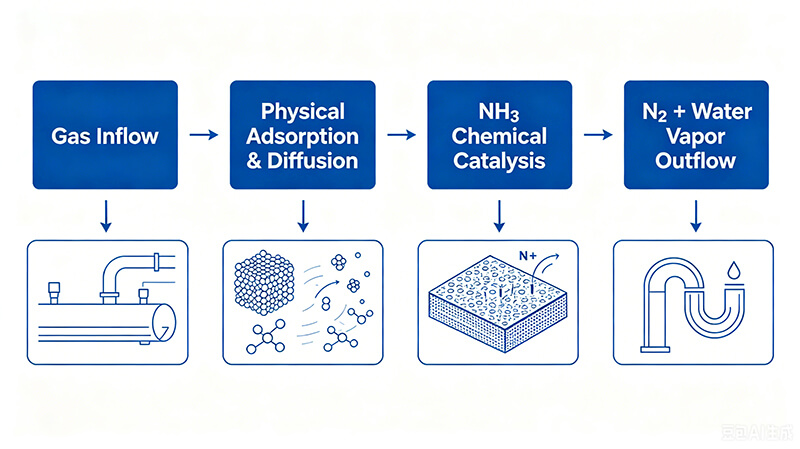
Because NO2 is a weak adsorbate on non-polar carbon surfaces, breakthrough occurs relatively quickly—often within minutes rather than hours under continuous-flow conditions. The spent carbon also releases a portion of the adsorbed NO2 as temperature rises, making thermal regeneration problematic without a chemical fixation step.The real performance leap comes from chemisorption. When the carbon surface is pre-loaded with ammonia (NH3), the NO2 molecule does not simply park on a pore wall—it reacts. Under the catalytic influence of the carbon surface, ammonia reduces NO2 to harmless nitrogen gas (N2) and water vapor, while a fraction of the NO2 forms stable ammonium nitrate (NH4NO3) complexes that remain permanently bound within the pore structure. This dual pathway—catalytic reduction plus salt formation—effectively locks the contaminant inside the carbon bed, preventing desorption and delivering breakthrough times that can exceed those of unimpregnated carbon by a factor of 5 to 15, depending on operating conditions.
Why Ammonia Impregnation Makes the Difference?
Impregnated activated carbons are manufactured by saturating a high-quality base carbon—typically coal-based or coconut-shell-based granular activated carbon—with an aqueous ammonia solution, then drying the material under controlled temperature to leave a uniform distribution of NH3 molecules across the internal surface. The resulting media carries a surface pH in the alkaline range (typically pH 9–11), which is exactly what NO2—an acidic gas—needs to react efficiently. The carbon’s enormous specific surface area (800–1,200 m2/g) acts as the reaction platform, providing millions of active sites per gram for the NO2-ammonia reaction to proceed.This is not a simple acid-base neutralization; it is a heterogeneously catalyzed reaction in which the carbon substrate itself participates. The graphitic basal planes of activated carbon facilitate electron transfer between NO2 and NH3, lowering the activation energy of the reduction step. In practical terms, this means the reaction proceeds efficiently even at ambient temperatures (15–35°C), without the need for external heating or pressure. For gas-phase filtration systems—whether in HVAC units, industrial scrubbers, or respirator cartridges—this room-temperature activity is what makes ammonia-impregnated carbon economically viable as a consumable media rather than a capital-intensive catalytic converter.
Where Ammonia-Impregnated Carbon Is Used for NO2 Control ?
The versatility of impregnated carbon makes it suitable across a remarkably wide range of deployment scenarios, each with its own requirements for bed depth, contact time, and media form factor:Urban Air Purification and HVAC
Large buildings in high-traffic metropolitan areas increasingly incorporate activated carbon stages into their fresh-air intake systems. Ammonia-impregnated granular carbon filters strip NO2 from outdoor air before it enters occupied spaces, helping building operators meet indoor air-quality targets such as those defined by WELL and LEED standards. Typical bed depths range from 50 to 150 mm at face velocities under 0.5 m/s.
Industrial Stack-Gas Polishing
After primary scrubbing systems (wet scrubbers, selective catalytic reduction, or electrostatic precipitators), a downstream carbon-polishing bed captures the residual NO2 that slips through, enabling compliance with emission limits below 50 mg/Nm3. Pelletized impregnated carbon is often preferred here for its lower pressure drop and higher crush strength under stack conditions.
Personal Respiratory Protection
Military and industrial gas-mask canisters rely on ammonia-impregnated carbon as the primary NO2 barrier layer, often in combination with copper- or chromium-impregnated layers for multi-gas protection. The high activity per unit volume of impregnated carbon allows thin, lightweight cartridges that still meet NIOSH and EN breakthrough requirements.
Parking-Garage and Tunnel Ventilation
Enclosed vehicle environments generate sustained NO2 concentrations from diesel and gasoline exhaust. Impregnated carbon modules installed in ventilation exhaust shafts reduce the NO2 load before discharge to ambient air, helping operators meet local air-quality ordinances without major structural retrofits.
Key Factors That Govern NO2 Removal Performance
Choosing the right impregnated carbon and operating it correctly requires attention to several interdependent variables. Getting any one of these wrong can cut breakthrough time by half or more:Impregnant loading
Typical ammonia content ranges from 5% to 12% by weight. Higher loading extends service life but increases material cost and can elevate pressure drop if over-impregnation clogs micropores. For most industrial applications, an 8–10% loading strikes the best balance between capacity and accessible porosity.
Contact time
NO2 needs a minimum residence time of 0.1–0.3 seconds within the carbon bed to achieve meaningful conversion. This translates to bed depths of 25–75 mm at typical face velocities; thinner beds or higher velocities push the system into mass-transfer-limited territory where unreacted NO2 breaks through prematurely.
Relative humidity
This is the variable most often overlooked. Ammonia-impregnated carbon performs best at 40–70% RH. Below 30% RH, the surface reaction slows because water molecules assist in proton transfer during the NO2-NH3 reaction. Above 80% RH, excess moisture can physically block micropores and leach impregnant, reducing capacity. For outdoor installations, a pre-filter or humidity buffer layer is strongly recommended.
Temperature
While the catalytic reaction proceeds at ambient temperature, elevated inlet temperatures above 50°C can accelerate impregnant volatilization and shorten media life. The upper practical limit is around 60°C for continuous operation; beyond that, specialty high-temperature impregnated formulations should be considered.
Base carbon quality
The raw carbon’s iodine number—a proxy for total surface area—should be at least 900 mg/g. Coconut-shell and coal-based carbons are preferred for their high hardness and well-developed microporosity; wood-based carbons, while high in surface area, tend to generate more fines and pack less densely, shortening bed life in fixed-bed configurations.
Recommended Product Configurations
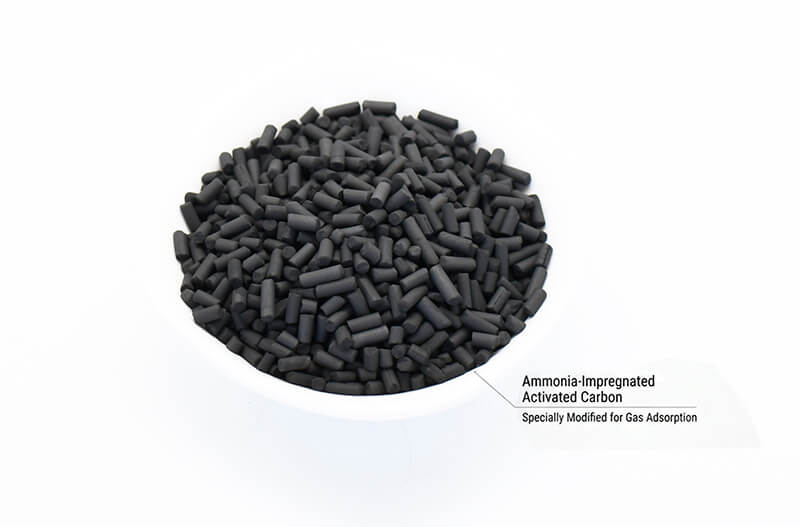
For the majority of NO2 removal projects, two product forms cover most requirements:4mm ammonia-impregnated granular activated carbon (cylindrical pellet). This is the workhorse format for fixed-bed industrial scrubbers and building-air intake systems. The pellet geometry delivers a favorable pressure-drop-to-surface-area ratio, and the 4 mm diameter balances bed permeability with adequate external surface for gas-film mass transfer. Typical specifications: iodine ≥ 950 mg/g, ammonia loading 8–10%, moisture ≤ 5%, hardness ≥ 95%.
12×40 mesh ammonia-impregnated granular activated carbon. For respirator cartridges, compact canister filters, and mobile air-purification units where bed volume is constrained, the smaller mesh size provides faster adsorption kinetics and higher volumetric activity per cubic centimeter of packed bed. Ash content is kept below 5% to minimize the risk of leaching or dusting in breathing-air applications.
| Property | 4 mm Ammonia-Impregnated Pellet | 12×40 Mesh Ammonia-Impregnated GAC |
|---|---|---|
| Iodine Number (mg/g) | ≥ 950 | ≥ 950 |
| Particle Size | 4 mm (cylindrical pellet) | 12×40 mesh (0.42–1.68 mm) |
| Ammonia Loading (wt%) | 8–10% | 8–10% |
| Moisture (%) | ≤ 5% | ≤ 5% |
| Hardness (%) | ≥ 95% | ≥ 92% |
| Ash Content (%) | ≤ 8% | ≤ 5% |
Both formats are available with customized ammonia loading and can be supplied in bulk, supersacks, or palletized drums depending on the project scale. For pilot trials, we recommend starting with a 25 kg sample and running a small-scale breakthrough test at your target face velocity and inlet concentration before committing to bed dimensions.