
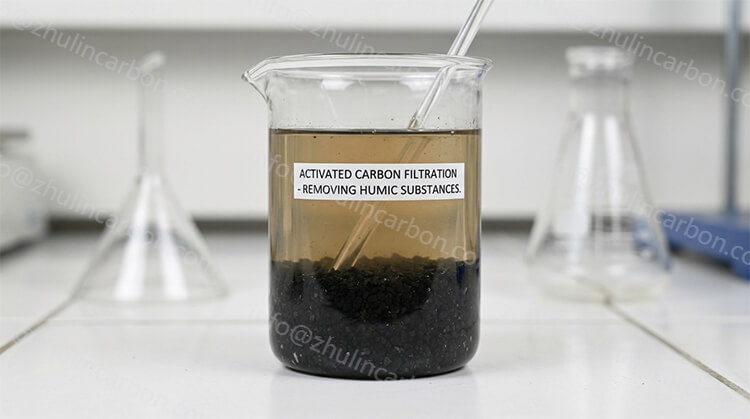
What Is Insoluble Humus?
Insoluble humus originates from the natural decomposition of plants and microorganisms and forms a mixture of humic acids, fulvic acids, and other organic macromolecules. These substances tend to bind with mineral particles and remain suspended in water. As a result, water containing insoluble humus typically shows:• noticeable yellow‑brown coloration
• earthy or musty odors
• higher TOC and COD levels
• increased difficulty in downstream disinfection
greater potential for forming disinfection by‑products (DBPs)
Because of its molecular complexity and colloidal nature, insoluble humus cannot be removed simply through sedimentation or basic filtration. More advanced adsorption processes—specifically activated carbon—are required
Why Activated Carbon Is Effective for Humus Removal
Activated carbon is widely used in drinking water treatment because it can adsorb a broad range of natural organic matter, including complex humic substances. However, the type and pore structure of the carbon play a critical role in achieving efficient humus removal.
Unlike microporous carbons used for gas purification, humus removal relies significantly on mesoporous structures that can accommodate larger organic molecules. Briquetted activated carbon with a high molasses number is ideal because it combines:
- a well‑developed mesoporous network
- strong adsorption capacity for high‑molecular organics
- excellent mechanical strength suitable for water filters
- stable and long‑term structural performance
- the ability to improve both taste and appearance of drinking water
This makes it indispensable for municipal water utilities seeking reliable and cost‑effective treatment solutions.
Why Choose Briquetted Activated Carbon with Molasses Number?
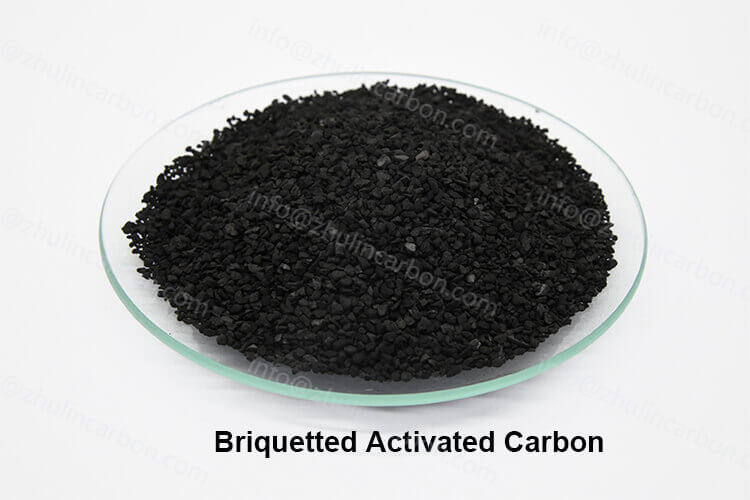
The molasses number is a recognized indicator of mesopore volume. A higher molasses value reflects better adsorption capability for large organic molecules such as humus. While iodine value measures microporosity, molasses value better predicts performance in colored organic matter removal.
Briquetted activated carbon with a high molasses number provides additional operational advantages. The briquette form enhances hydraulic stability, reduces pressure loss, and ensures low dust generation, making it suitable for continuous operation in drinking water plants. This combination of performance and durability is why municipal engineers frequently specify briquetted carbon for raw water treatment.
Typical Specifications for Humus Removal Carbon| Parameter | Specification |
|---|---|
| Type | Briquetted activated carbon |
| Molasses Number | 150–300 |
| Iodine Number | 800–1000 mg/g |
| BET Surface Area | 900–1100 m²/g |
| Hardness | ≥ 95% |
| Moisture | ≤ 5% |
| Particle Size | 4 mm or 4–8 mesh |
| Bulk Density | 450–550 kg/m³ |
| Application | Drinking water purification, humus and color removal |
These parameters ensure the material performs effectively when dealing with high‑molecular humic substances commonly found in surface water sources.
How Activated Carbon Removes Insoluble Humus
The humus removal process involves more than simple physical adsorption. As raw water flows through the carbon bed, humic substances diffuse into the mesoporous structure. Their large molecular size allows them to attach to the carbon surface through natural attraction between organic molecules and the pores of the activated carbon. This multilayer adsorption mechanism gradually reduces color, odor, and organic load.An important advantage of briquetted activated carbon is its ability to maintain adsorption efficiency over extended service cycles, even under heavy organic loading. This stability helps reduce operational costs for water treatment plants.
Applications in Drinking Water Treatment
Activated carbon with a high molasses number is primarily used in drinking water systems where natural organic matter must be controlled. Key application areas include:• municipal surface water treatment plants
• groundwater systems with high organic content
• pretreatment for membrane filtration systems
• taste and odor control units
• beverage, food, and bottled water production
Because insoluble humus can interfere with downstream disinfection and filtration, incorporating activated carbon improves overall process efficiency and water safety.