
In this process, activated carbon does not directly "extract" metallic gold from the ore particles, but rather adsorbs the gold-containing complexes already in the solution. Research shows that since the 1970s, activated carbon adsorption has become an important industrial method for recovering gold from gold-containing cyanide solutions, with its main advantages including high adsorption efficiency, wide availability of raw materials, mature technology, and ease of recycling.
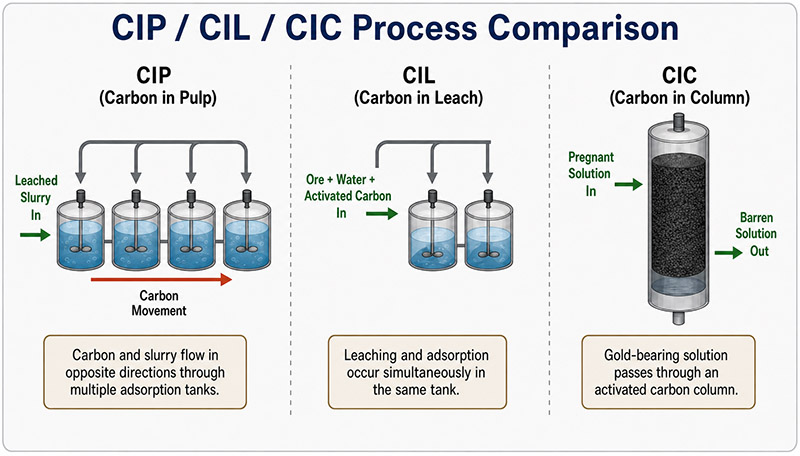
In actual production, activated carbon for gold recovery is mainly used in the following three processes:
Carbon-in-Pulp (CIP);
Carbon-in-Leach (CIL);
Carbon-in-Column (CIC).
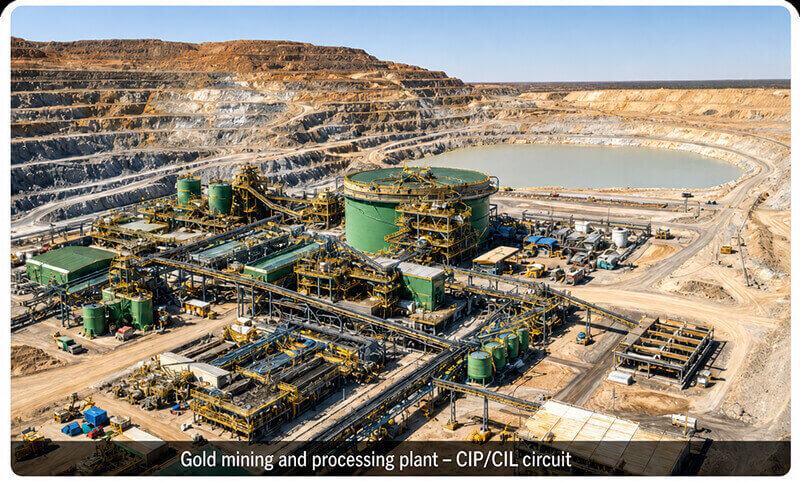
The adsorption rate, gold loading capacity, mechanical strength, and abrasion resistance of activated carbon directly affect the gold recovery rate, carbon loss, and the overall operating cost of the plant.
Why can activated carbon be used for gold recycling?
In common gold leaching processes, gold in the ore enters the solution and forms stable gold-containing complexes. Taking traditional cyanide leaching as an example, gold usually exists in the leaching solution as dicyanate ions, namely Au(CN)2−.Its simplified reaction can be expressed as:4Au+8CN−+O2+2H2O→4Au(CN)2−+4OH−
Activated granular carbon, after activation treatment, possesses a well-developed pore structure and a large internal surface area, enabling it to adsorb and enrich gold complexes from low-concentration gold-containing solutions. Compared to directly treating large quantities of low-concentration leachate, concentrating gold onto a small amount of activated carbon before desorption and electrodeposition helps to reduce the scale of subsequent treatments.
Why do most customers choose coconut shell activated carbon for gold refining?
.jpg)
Activated carbon used in gold recovery can be prepared from carbon-containing raw materials such as coal, wood, and coconut shells. However, industrial CIP, CIL, and CIC systems typically prioritize the mechanical strength, abrasion resistance, and particle size stability of the activated carbon.
Coconut shell activated carbon has the following characteristics:
High Mechanical Strength
Activated carbon is subjected to continuous friction and impact in mixing tanks, screening equipment, conveying pipelines, and regeneration systems. High-strength activated carbon is less prone to breakage, helping to reduce the risk of gold-loaded carbon powder being lost with tailings.
Well-developed Pore Structure
A suitable pore size distribution facilitates the entry of gold-containing complexes into the activated carbon interior, where they are adsorbed and enriched on the pore surface.
Good Abrasion Resistance
A low abrasion rate reduces the generation of fine carbon, lowering screening load and carbon loss.
Relatively Uniform Particle Size
A stable particle size distribution helps maintain the stability of slurry flow, screening, and carbon transfer processes.
Desorption, Regeneration, and Reuse Capability
After desorption, gold-loaded activated carbon can be partially regenerated through thermal regeneration and returned to the adsorption loop for continued use.
Activated carbon suppliers for gold recycling typically consider high hardness, low abrasion, low flaky particle content, stable particle size, and good gold adsorption kinetics as key performance characteristics of coconut shell gold-bearing activated carbon.
The main processes for activated carbon in gold refining
1. Carbon-In-Pulse (CIP) Process
CIP stands for "Carbon in Pulp."In the CIP process, the slurry first undergoes gold leaching and then enters an activated carbon loop consisting of multiple adsorption tanks. The leached slurry contains dissolved gold. Granular activated carbon is added to the adsorption tanks, causing the gold complex to transfer from the liquid phase to the surface and internal pores of the activated carbon.
The slurry typically flows sequentially through the adsorption tanks in one direction, while the activated carbon moves in the opposite direction, stage by stage. This countercurrent operation facilitates contact between fresh or low-gold-loaded activated carbon and the low-concentration tail-end slurry, while simultaneously allowing high-gold-loaded activated carbon to contact the higher-concentration slurry, thereby improving the adsorption driving force and activated carbon utilization.
Key characteristics of CIP include:
• Leaching and activated carbon adsorption are completed in stages;
• Relatively clear process control;
• Easy to optimize leaching and adsorption conditions separately;
• High requirements for the wear resistance and particle size stability of the activated carbon.
2. Carbon-In-Leach (CIL)
CIL is an abbreviation for "Carbon in Leach," commonly known as the carbon-leaching process.Unlike CIP, CIL combines gold leaching and activated carbon adsorption in the same tank. Gold in the ore enters the solution while being adsorbed by the activated carbon, allowing the leaching and adsorption processes to occur simultaneously.
Key features of CIL include:
• Simultaneous leaching and adsorption;
• Relatively compact process flow;
• Ability to promptly reduce the gold concentration in the solution, maintaining the driving force for further leaching;
Potential advantages when processing ores with "gold-stealing" characteristics.
"Gold-stealing" refers to the re-adsorption of dissolved gold onto the ore surface by naturally occurring carbonaceous substances or other adsorbent components in the ore, resulting in gold loss with the tailings. In the CIL process, specialized activated carbon can compete with these naturally occurring adsorbents for gold-containing complexes, thereby reducing the impact of gold-stealing. However, the actual effectiveness still depends on the ore properties and the overall process design. (sciencedirect.com)
3. Carbon in Column (CIC)
CIC stands for "Carbon in Column," commonly known as carbon column adsorption or column-type activated carbon adsorption.CIC primarily treats clear gold-bearing solutions, rather than solid-liquid mixed slurries. The gold-bearing solution passes through an adsorption column packed with granular activated carbon; the gold is trapped within the activated carbon, and the treated low-gold-content solution is discharged from the column.
CIC is commonly used for:
•Heap leaching of gold-bearing precious solutions;
•Recovery of clear gold-bearing solutions;
•Treatment of low-grade ore leaching solutions;
•Gold recovery from certain tailings or circulating solutions.
Because the solution needs to pass stably through the carbon bed, CIC systems require particular attention to activated carbon particle size, bed pressure drop, dust content, mechanical strength, and hydraulic conditions.
Complete process of activated carbon gold recycling
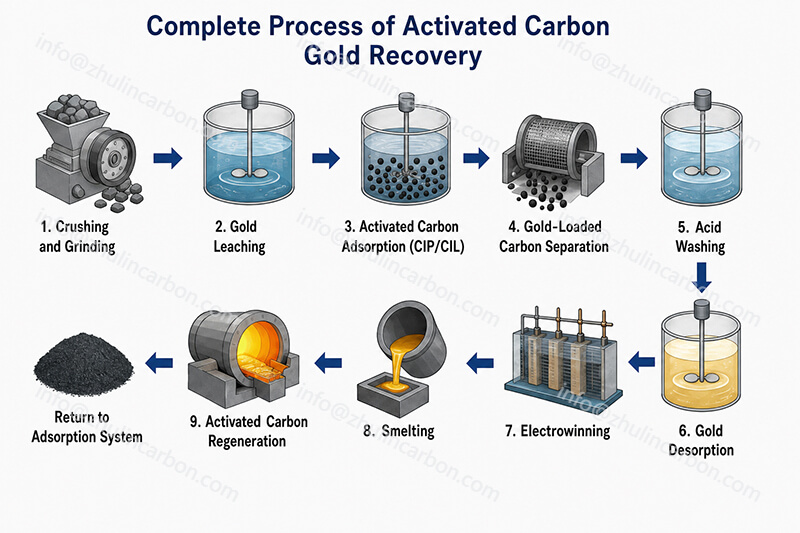
A typical activated carbon gold recovery process usually includes the following steps:
Ore crushing and grinding → Pretreatment → Gold leaching → Activated carbon adsorption → Gold-loaded carbon screening → Acid washing → Desorption → Electrowinning → Smelting → Activated carbon regeneration → Return to the adsorption system
1. Crushing and Grinding
First, the gold-bearing ore is crushed and ground to a suitable particle size for leaching, exposing as much gold as possible within the mineral. Ore particle size affects leaching rate, reagent consumption, and slurry flow.For refractory gold ores, conventional grinding alone may not be sufficient to release gold, and pretreatment processes such as oxidative roasting, pressurized oxidation, bio-oxidation, or ultrafine grinding may be required.
2. Gold Leaching
Under controlled conditions, the gold in the ore is converted into soluble gold-bearing complexes, forming a gold-bearing solution or gold-bearing slurry.Leaching efficiency is affected by the following factors:
Gold occurrence state;
Ore particle size;
Pulp concentration;
Redox conditions;
pH and leaching agent concentration;
Copper, sulfur, and other consumable minerals;
Natural carbonaceous material in the ore.
3. Activated Carbon Adsorption
After the gold-bearing solution or slurry comes into contact with granular activated carbon, the gold complex migrates to the outer surface of the activated carbon, then diffuses through the pores into the interior of the activated carbon and is adsorbed.Industrial CIP and CIL systems typically do not operate at true adsorption equilibrium, therefore the adsorption rate is particularly important. Studies indicate that improving adsorption kinetics allows more gold to enter the activated carbon within the same time frame, thereby reducing the number of adsorption stages, reducing equipment size, or increasing gold loading levels.
4. Gold-Loaded Activated Carbon Separation
The activated carbon after gold adsorption is called "gold-loaded carbon." This gold-loaded carbon is separated from the slurry or solution using screening equipment and then transported to the subsequent processing system.If the activated carbon strength is insufficient, a large amount of fine carbon will be generated during stirring and transportation. These fine gold-loaded carbon particles may pass through the screen and enter the tailings, causing direct gold loss. Therefore, wear resistance not only affects the amount of activated carbon consumed but also directly affects the gold recovery rate.
5. Acid Washing
During long-term operation, gold-loaded carbon may adsorb or deposit calcium salts, magnesium salts, carbonates, and other inorganic substances, clogging some pores. The main purpose of acid washing is to remove these inorganic deposits, creating conditions for subsequent desorption and regeneration.The specific acid washing process should be determined based on the mine water quality, scale type, equipment materials, and process design, and should be operated by qualified professionals.
6. Gold Desorption
Desorption, also known as elution, aims to transfer gold from the gold-loaded activated carbon to a smaller, more concentrated solution.Common industrial desorption systems include the Zadra process and the AARL process. A complete desorption plant typically consists of units for acid washing, desorption, rich liquor treatment, activated carbon dehydration, and regeneration.
7. Electrowinning and Smelting
The high-concentration gold-bearing solution obtained from desorption enters the electrowinning system, where gold is deposited on the cathode material, forming gold-bearing mud. After cleaning, drying, and smelting, the gold-bearing mud can be used to produce alloyed gold ingots.
This stage completes the gradual enrichment of gold from low-concentration ore and leachate to high-concentration metallic products.
8. Activated Carbon Regeneration: Organic matter, inorganic salts, and other contaminants may still remain on the surface and in the pores of the desorbed activated carbon. Thermal regeneration is usually required to restore its adsorption capacity.
After cooling, sieving, and removal of fine carbon, the regenerated activated carbon can be returned to the CIP, CIL, or CIC circuits for continued use. Proper regeneration can extend the life of activated carbon, but improper control of temperature, atmosphere, and residence time can damage the pore structure or reduce mechanical strength. Studies show that activated carbon used without effective regeneration may exhibit lower gold adsorption capacity due to pore occupancy.
Why does the quality of activated carbon affect the profitability of gold mines?
Gold is a high-value product; even a small increase in gold loss per ton of slurry or per cubic meter of solution can have a significant economic impact over the long term.Inconsistent quality activated carbon can cause:
•Decreased gold adsorption rate;
•Increased gold concentration in the adsorption tailings;
•Premature deactivation of activated carbon;
•Loss of gold-loaded fine carbon with the tailings;
•Increased carbon replenishment;
•Increased desorption and regeneration frequency;
•Instability in the operation of screens, pumps, and pipelines;
•Increased unit gold recovery costs for the plant.
Therefore, the purchase of gold-loaded activated carbon should not be based solely on price per ton.
The total cost of activated carbon includes: purchase cost + carbon loss cost + desorption and regeneration cost + equipment maintenance cost + value of unrecovered gold.
A lower-priced activated carbon with a higher abrasion rate may ultimately have a higher overall cost than high-strength gold-retardant activated carbon with stable performance.
Conclusion
Activated carbon is a crucial adsorbent material in modern hydrometallurgical gold recovery processes, widely used in CIP (Carbon-in-Pulp), CIL (Carbon-in-Liquid), and CIC (Carbon-in-Column) processes. Its core function is to selectively adsorb gold-containing complexes from low-concentration gold solutions or slurries, enriching the gold onto the gold-loaded carbon, thus creating conditions for subsequent acid washing, desorption, electrowinning, and smelting.A suitable activated carbon for gold refining must not only possess high adsorption capacity but also exhibit rapid adsorption kinetics, good mechanical strength, low abrasion rate, stable particle size distribution, and reliable recyclability. Comparing iodine value, specific surface area, or purchase price alone cannot fully assess the actual value of gold-producing activated carbon.
Only by combining high-quality activated carbon for gold recovery with rational process design and standardized safety and environmental management can the loss of fine carbon and gold be reduced, the adsorption recovery rate improved, and the overall operating costs of gold production lowered.