
To ensure compliance with emission standards and protect downstream equipment, industries require a high‑performance purification solution. Among the most efficient adsorbents available today is CuO activated carbon, a copper oxide–impregnated activated carbon designed specifically for deep H₂S removal.
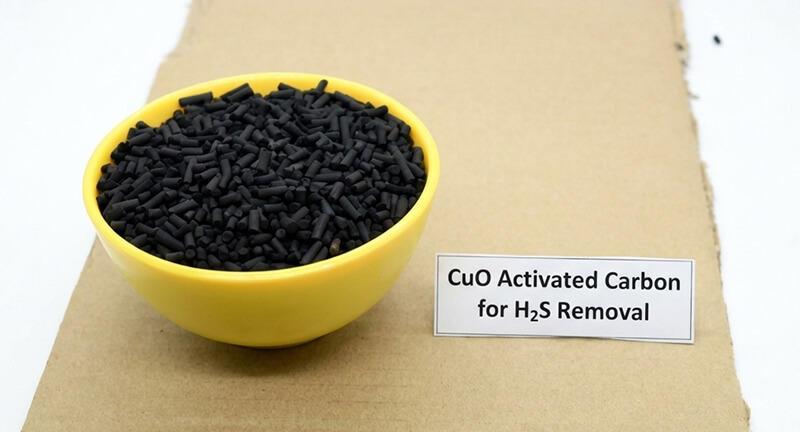
What Is CuO Activated Carbon?
CuO activated carbon is an enhanced catalytic carbon impregnated with copper oxide (CuO).
While standard activated carbon removes H₂S primarily through physical adsorption, CuO‑modified carbon uses chemical reactions to convert H₂S into stable, non‑hazardous compounds.
This catalytic mechanism allows CuO activated carbon to deliver high sulfur capacity, stable performance, and extremely low outlet H₂S concentrations—even under demanding industrial conditions.
| Parameter | Unit | Typical value |
|---|---|---|
| Product name | — | CuO impregnated activated carbon |
| Form | — | Pellet / columnar |
| CuO loading | wt% | 5–10 |
| Pellet diameter | mm | 3mm, 4mm |
| BET surface area | m²/g | 600–900 |
| Bulk density | g/cm³ | 0.45–0.60 |
| Moisture content | wt% | <10 |
| Ash content | wt% | 5–15 |
| Hardness | % | >90 |
| pH | — | 7–9 |
How CuO Activated Carbon Removes H₂S
Hydrogen sulfide removal with CuO carbon is based on an oxidation‑reaction mechanism:
-
Adsorption:
H₂S molecules are first adsorbed onto the porous structure of activated carbon. -
Chemical Reaction with CuO:
Copper oxide reacts with H₂S, converting it into:• copper sulfide (CuS)
• water (H₂O)CuO + H₂S → CuS + H₂O
-
Stable Storage:
The resulting CuS is non‑volatile, non‑toxic, and remains safely embedded inside the activated carbon structure.
Because the reaction forms stable solids, CuO carbon maintains high efficiency over a long operational cycle and prevents H₂S breakthrough.
Why Choose CuO Activated Carbon?
1. Extremely High H₂S Removal Efficiency
CuO’s strong reactivity allows near‑complete removal of H₂S, even at high inlet concentrations.
2. No Need for Oxygen or Moisture
Unlike some catalytic carbons, CuO activated carbon does not require oxygen or humidity to function, making it suitable for dry gas environments.
3. Very Low Outlet Concentrations
Outlet H₂S levels can reach ppb range, protecting sensitive engines, turbines, and catalysts.
4. Long Service Life
High sulfur loading capacity reduces media replacement frequency and lowers operating cost.
5. Stable, Non‑Hazardous Byproducts
The formation of CuS ensures safe handling and disposal.
6. High Mechanical Strength
Pelletized CuO activated carbon offers low dust, low attrition, and low pressure drop.
Applications of CuO Activated Carbon for H₂S Removal
CuO activated carbon is used widely across various industries that require high‑efficiency desulfurization:
1. Biogas Purification
Biogas commonly contains high H₂S concentrations that corrode engines and damage CHP units.
CuO carbon ensures stable, deep H₂S removal for both raw gas and polishing stages.
2. Natural Gas and Synthetic Gas Treatment
Protects pipelines, compressors, and catalytic systems from sulfur corrosion.
3. Petrochemical Industry
Used in hydrocarbon processing, refinery off‑gas purification, and sulfur removal from fuel gases.
4. Chemical Manufacturing
Removes H₂S from chemical reactors, process gas streams, and vent gases.
5. Landfill Gas and Waste Management
Captures H₂S and odor compounds during waste storage and decomposition.
6. Wastewater Treatment Facilities
Controls odor emissions and protects downstream air treatment equipment.
7. Metal Processing and Semiconductor Manufacturing
Prevents contamination in precision manufacturing environments requiring ultra‑pure gases.
Choosing the Right CuO Activated Carbon
Selecting the correct grade depends on:
• H₂S concentration (ppm or %)
• Gas flow rate and velocity
• Operating temperature
• Moisture level in the gas stream
• Required outlet H₂S level
• System design and bed dimensions
A properly chosen CuO activated carbon ensures maximum efficiency and long media life.
Conclusion
CuO activated carbon is one of the most effective materials for H₂S removal across industrial gas purification systems. Its strong catalytic reactivity, long service life, and ability to achieve extremely low outlet concentrations make it ideal for biogas upgrading, petrochemical processing, natural gas treatment, and odor control applications. If you need help selecting a suitable CuO activated carbon grade or designing an H₂S removal system, we can provide professional guidance and customized solutions tailored to your application.