
This article will guide you through the role and advantages of activated carbon in vodka production and how to choose the right activated carbon product.
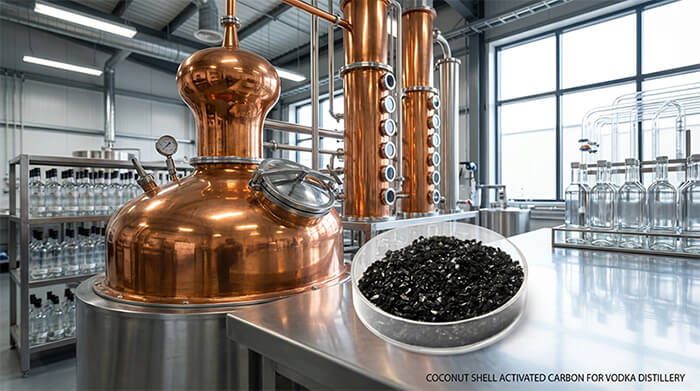
Why is activated carbon used in vodka production?
Even after distillation, small amounts of undesirable components may remain in the spirit, such as:• Higher alcohols (e.g., isopropanol, n-propanol)
• Aldehydes
• Esters
• Organic acids
• Off-flavors and odors
These components can affect the crisp taste of vodka and may cause a harsh or unpleasant aftertaste.
Activated carbon filtration is one of the most effective methods for removing these trace impurities. Its extremely large surface area and well-developed pore structure allow it to efficiently adsorb small molecules that affect the flavor of the spirit, resulting in a purer liquid.
The main application of activated carbon in vodka production:
1. Removing off-flavors and improving tasteActivated carbon can adsorb impurities that affect smoothness, making the vodka smoother and cleaner on the palate.
2. Improving aroma
Vodka emphasizes "smoothness and purity," and excessive off-flavors can disrupt the aromatic balance. Activated carbon helps maintain a refreshing and delicate aroma.
3. Reducing undesirable components
Components detrimental to flavor, such as aldehydes and esters, can be significantly reduced by activated carbon.
4. Stabilizing liquor quality
Activated carbon filtration ensures greater consistency in flavor across batches, meeting the stability requirements of commercial spirits.
Types of Activated Carbon Commonly Used in Vodka Distilleries
Based on the filtration process, the following two main categories are typically used:I. Granular Activated Carbon (GAC)
• Suitable for continuous filtration systems• High hardness and resistance to pulverization
• Longer service life
• Primarily used in large-scale vodka production lines
II. Powdered Activated Carbon (PAC)
• Suitable for batch production or small-scale processing• Fast reaction speed
• It can be used for precise flavor adjustment
PAC is often used for fine-tuning the finished product, such as improving subtle defects in a particular batch of vodka.
How to choose the right activated carbon for vodka?
Vodka distilleries typically focus on the following indicators:• Higher specific surface area means stronger adsorption capacity
• High micropore content effectively adsorbs small molecular impurities
• High hardness prevents carbon powder from entering the spirit
• High purity, odorless, and does not introduce impurities
• Moderate decolorization ability, without disrupting the flavor balance of the spirit
For distilleries pursuing "ultimate purity," coconut shell-based activated carbon is commonly used due to its microporous structure, which is ideal for adsorbing small molecular impurities.
Why is coconut shell activated carbon the most suitable for filtering vodka?
.jpg)
Coconut shell activated carbon is renowned for its dense structure and abundant micropores, making it particularly suitable for adsorbing small molecular impurities in vodka that affect its taste (such as aldehydes, esters, and off-flavor substances). Its proportion of micropores is far higher than that of coal-based or wood-based activated carbon, resulting in superior performance in deep purification and flavor enhancement.
Furthermore, coconut shell carbon has high hardness and does not easily produce carbon powder, thus not affecting the clarity and transparency of vodka, nor introducing any other off-flavors. It is the preferred material for fine filtration (polishing) among many high-end vodka brands.
| Item | Typical Range |
| Iodine Value | 1000–1200 mg/g |
| Surface Area (BET) | 950–1250 m²/g |
| Particle Size | 12×40mesh |
| Hardness | ≥98% |
| Moisture | ≤5% |
| Ash Content | 2–4% |
| Pore Structure | High Micropore Volume |
Conclusion
For vodka distilleries, selecting the right activated carbon and filtration process is a crucial step in ensuring product consistency, purity, and high quality. Whether for large-scale industrial production or small-to-medium-sized distilleries, activated carbon can significantly improve the clarity and flavor profile of the vodka.If you need to select the appropriate activated carbon for vodka filtration, we can recommend the best solution based on your equipment, process, and desired flavor profile.