
At present, most compressors must use lubricating oil when working, which inevitably causes oil impurities in compressed air. Its main components are hydrocarbon compounds, which affect the use of compressed air in subsequent processes. Therefore, the oil content in compressed air is one of the important indicators in its quality standards.
Why Oil Removal Is Important in Air Compressor Systems
Compressed air may contain residual lubricating oil from the compressor itself, especially in oil-lubricated systems. Even in more advanced systems, small amounts of oil vapor can still pass through separators and filters. If not properly removed, these impurities may cause several problems:• Contamination of sensitive equipment
• Poor performance of pneumatic tools
• Product defects in industries such as food, electronics, and pharmaceuticals
• Fouling of downstream pipelines and valves
• Odor and air quality issues
For applications requiring clean and dry air, oil removal is not optional — it is essential.
How does activated carbon remove oil from an air compressor?
Activated carbon removes oil contaminants through adsorption. Its porous structure contains a large number of micropores and mesopores, which provide a high internal surface area. When compressed air passes through the carbon bed, oil vapor and hydrocarbon molecules are trapped on the carbon surface.This process is especially effective for:
• Oil vapor
• Hydrocarbon odors
• Organic impurities
• Residual compressor oil mist
Compared with ordinary mechanical filtration, activated carbon can handle smaller molecular contaminants that are difficult to remove by conventional filters alone.
Selecting the right activated carbon
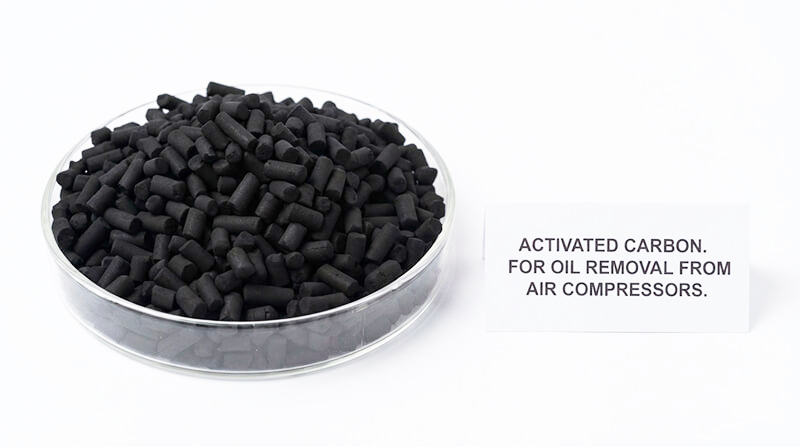
When selecting activated carbon for oil removal from air compressor systems, columnar activated carbon with a CTC value of 80 is a practical and reliable choice. CTC80 indicates a balanced adsorption performance, making the material suitable for removing oil vapor and hydrocarbon impurities from compressed air.
Compared with lower-grade carbon, CTC80 columnar activated carbon offers better adsorption capacity, more stable performance, and improved service life in air treatment applications. Its cylindrical form also helps reduce pressure drop and supports smooth airflow through the filtration bed, which is important for continuous compressed air systems.
| Parameter | Typical Specification |
|---|---|
| Activated Carbon Type | Columnar activated carbon |
| CTC Value | 80 |
| Iodine Number | 900–1100 mg/g |
| Ash Content | ≤ 10% |
| Moisture Content | ≤ 5% |
Applications of Activated Carbon in Compressed Air Systems
Activated carbon for oil removal from air compressor systems is used in a variety of industries, including:• Food and beverage processing
• Pharmaceuticals
• Electronics manufacturing
• Precision instrumentation
• Laboratory air systems
• Spray painting and coating lines
• Packaging operations
In these fields, even trace amounts of oil can cause serious quality problems, so reliable adsorption media are necessary.
Customer Case
In helium compressor systems, removing lubricant oil from the discharge gas is critical to maintaining gas purity and protecting downstream equipment. In one typical application, the compressor discharge pressure was 30 barg, with a flow rate of 1000 Nm³/h and continuous operation of 24 hours per day. The target was to reduce lubricant oil content from 5 ppm to 3 ppb, which requires very high adsorption efficiency.Recommended Activated Carbon
For this type of helium compressor exhaust oil removal, wood-based activated carbon is generally the preferred choice because of its developed pore structure and strong adsorption performance for low-concentration organic vapors. However, coal-based columnar activated carbon can also be selected depending on system design, operating conditions, and cost considerations.
If columnar CTC80 activated carbon is used, the adsorption calculation is commonly based on:
Adsorption efficiency: 50%
Lubricant oil molecular weight: 300
These values are often used for preliminary engineering estimation in oil vapor adsorption systems. For more precise design, the actual oil composition, operating temperature, and bed configuration should also be considered.